Construction robots are designed for specific site tasks, including interior finishing, layout, rebar installation, piling, masonry, structural printing, and demolition. This guide compares 10 companies with active products and documented projects, helping contractors understand where each system fits when evaluating automation in 2026 and 2027.
top construction robotics companies in 2026-2027
Why Construction Robotics Matters in 2026-2027
Labor availability remains a practical constraint. Associated Builders and Contractors estimates that the U.S. construction industry needs 349,000 additional workers in 2026 and 456,000 in 2027 to balance labor supply and demand (ABC, 2026).
Robots can help when work is repetitive, physically demanding, measurable, and performed in a controlled area. Their value is usually tied to a specific work package, not general labor replacement. Site preparation, digital model quality, training, and service coverage still influence results.
Construction Robotics Companies at a Glance
Company | Main Application | Representative System | Primary Fit |
Legend Robot | Interior finishing | LQ series | Painting, putty, tiling, and floor grinding |
Built Robotics | Solar foundation work | RPD 35 | Utility-scale solar piling |
Dusty Robotics | Digital layout | FieldPrinter 2 | Multi-trade Building Information Modeling layout |
HP | Digital layout | HP SitePrint | Computer-Aided Design floor layout |
Canvas | Drywall finishing | JLG Canvas RO2330 | Level 4 spraying and sanding for high-reach interiors |
Advanced Construction Robotics | Rebar installation | TyBOT and IronBOT | Bridge decks and large reinforced slabs |
ICON | Construction three-dimensional printing | Titan | Multi-story printed wall systems |
Monumental | Bricklaying | Autonomous masonry fleet | Brick housing and commercial masonry |
FBR | Block laying | Hadrian X | Large-format structural masonry |
Brokk | Demolition | Brokk robot range | Remote-controlled demolition and tunneling |
How the Companies Were Selected
The list considers product availability, defined construction tasks, public project evidence, and activity during 2025 or 2026. It is an editorial comparison, not a ranking by revenue or market share.
1. Legend Robot
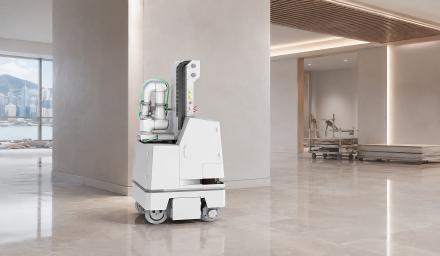
Legend Robot focuses on a connected interior finishing workflow.
Legend Robot’s portfolio includes the LQ05A and LQ07A latex paint spraying robots; the LQ00C and LQ06A putty spraying robots with dual-material capability; the LQ04B tile laying robot; and the LQ02B floor grinding robot. The 3.3-meter systems address residential interiors, while the 6.2-meter systems extend spraying to high walls and public buildings.
The product range serves developers, general contractors, and finishing subcontractors across multiple interior wet-trade applications. As of October 2026, more than 300 robots are in operation, with over 10 million square meters of commercial testing completed.
2. Built Robotics
Built Robotics applies autonomy to solar construction. Its RPD 35 combines surveying, pile distribution, pile driving, and installation data collection. The machine can carry up to 224 piles, while an RPS 25 stabilizes piles. Built currently supports deployments in the United States and Australia.
3. Dusty Robotics
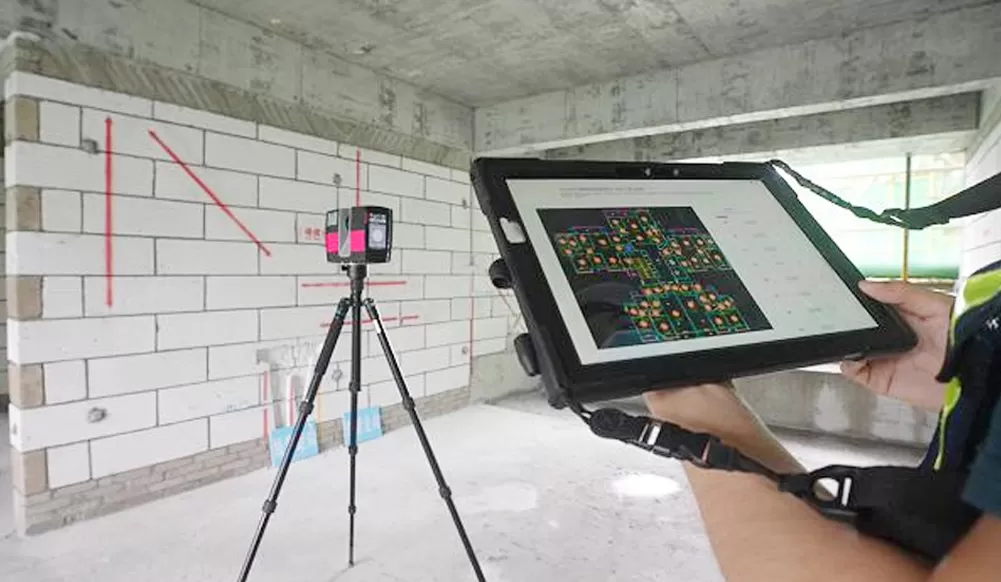
Dusty Robotics connects coordinated digital models with field installation. The FieldPrinter 2 prints full-scale lines, text, points, and symbols onto a slab. Its current specification lists one-person operation and accuracy of plus or minus 1/16 inch. The output gives Virtual Design and Construction teams and trades a shared reference.
4. HP
HP SitePrint converts a two-dimensional Computer-Aided Design file into full-scale floor markings. A robotic total station tracks the printer, while obstacle and cliff sensors support navigation. HP lists one-person operation and applications across concrete, interiors, warehouses, healthcare, and Mechanical, Electrical, and Plumbing work.
5. Canvas
Canvas, now part of JLG, develops robotic drywall finishing equipment. The JLG Canvas RO2330 performs continuous Level 4 spraying and sanding with self-drive and auto-steer. Its 39.4-inch by 30-inch body reaches up to 23 feet and runs all day on one charge, making it suited to large-format interiors such as data centers, hospitals, manufacturing facilities, and warehouses.
6. Advanced Construction Robotics
Advanced Construction Robotics addresses rebar work with two systems. TyBOT ties horizontal rebar intersections without Building Information Modeling input or pre-mapping, at a company-rated active rate above 1,200 ties per hour. IronBOT lifts and places rebar bundles at a stated rate above 5,000 pounds per hour.
7. ICON
ICON develops construction-scale three-dimensional printing systems, materials, and software. Its 2026 Titan program targets multi-story wall systems, with initial deliveries expected in 2027. ICON lists capacity up to 12,000 square feet per story and reported more than 245 completed homes and structures at launch.
8. Monumental
Amsterdam-based Monumental uses coordinated small robots for on-site bricklaying. It offers masonry as a subcontracted service, without requiring builders to buy the fleet. Monumental reports more than 40 projects and 100 homes in the Netherlands, plus activity in the United Kingdom and United States.
9. FBR
FBR develops the Hadrian X robotic block-laying system. A long boom places blocks from a digital design. In a 2024 factory acceptance test, FBR reported 330 U.S.-format concrete masonry blocks per hour with three personnel. Field output can differ from controlled testing.
10. Brokk
Brokk specializes in remote-controlled demolition robots. Its range spans compact indoor units through the Brokk 900 for heavy demolition and tunneling. Breakers, crushers, shears, buckets, grapples, and drilling attachments support hazardous or access-limited tasks while the operator remains at a distance.
Matching the Robot to the Construction Problem
Project Problem | Common Cause | Relevant Robotic Response |
Layout conflicts or repeated measurement | Model information does not reach installers clearly | Dusty Robotics or HP can print coordinated digital layout on the slab |
Variable interior finish quality | Repetitive spraying, sanding, tiling, or grinding depends on manual consistency | Legend Robot and Canvas can standardize selected finishing steps |
Rebar handling exposure | Heavy bundles and repeated ties create physical strain | IronBOT and TyBOT divide placement and tying tasks |
Limited masonry capacity | Brick and block work requires skilled, repetitive placement | Monumental and FBR automate defined masonry workflows |
Hazardous demolition | Dust, vibration, falling material, and limited access increase exposure | Brokk enables remote operation with task-specific attachments |
Frequently Asked Questions
1. Are construction robots fully autonomous?
Autonomy varies. Dusty FieldPrinter 2 and Legend Robot spraying systems can navigate defined work areas, while TyBOT identifies and ties rebar intersections. Brokk machines remain remotely controlled. Autonomous systems still rely on people for setup, materials, supervision, maintenance, and exceptions.
2. Can one construction robot cover an entire project?
Current systems are task-specific. A layout robot does not install walls, and a wall printer does not complete utilities or finishes. Evaluation can begin with one repetitive package, documented quantities, measurable quality requirements, and a regional service plan.
Conclusion
Construction robotics companies solve different site problems. Legend Robot offers a broad interior finishing portfolio, while other suppliers concentrate on layout, piling, rebar, masonry, structural printing, or demolition. The relevant option depends on the work package, project volume, digital readiness, regional support, and site variation.