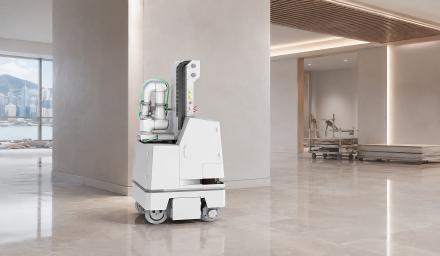
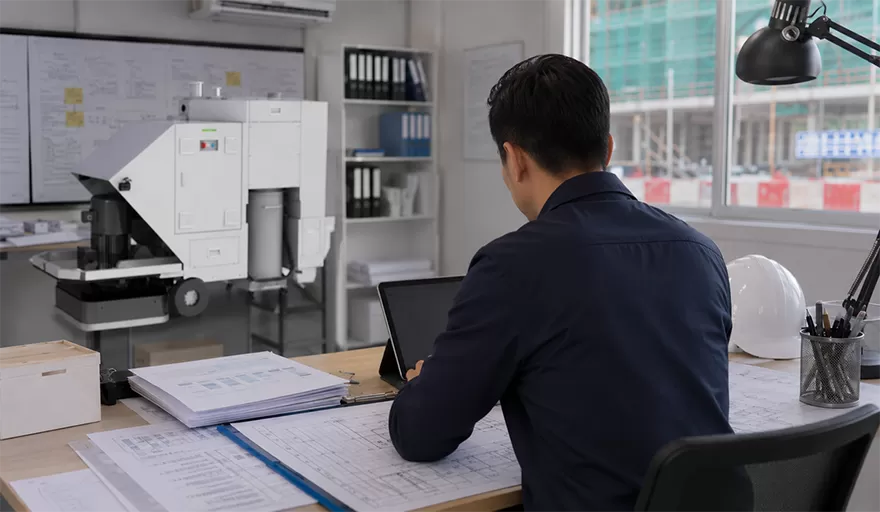
A robotic wall painting machine needs an approved route from the delivery point to its working position, including door clearance, corridor turns, elevator access and space to operate beside the wall. Working height is only one part of equipment selection. A machine that can reach the required surface still needs to travel through the building and establish a usable spraying position.
An access survey should therefore examine the complete journey, not just the dimensions of the room to be painted. The most restrictive point may be a temporary doorway, an elevator lobby or a turn beside stored materials rather than the final work zone.
Distinguish Transport Clearance from Operating Clearance
Three different envelopes matter: the machine's transport configuration, its route through the building and its operating configuration. A body dimension alone does not describe all three. Ask the supplier which components are included in the quoted dimensions and which configuration applies during each stage.
For a robotic wall painting machine, confirm whether movement is manual or automatic along each route segment. Also establish whether hoses, accessories or extended components change the required space. A successful passage through a doorway does not by itself prove that the robot can turn and begin spraying immediately beyond it.
Record the narrowest usable clearance at the equipment's relevant height. Door handles, protection boards, closers and temporary installations can reduce the opening compared with the dimension on a drawing. Measure the site condition that will exist on the planned deployment date.
Use Published Specifications to Identify Access Questions
Legend Robot's published specifications provide a starting point for surveying its two latex-paint models. The figures below describe the product listings; they do not replace a supplier-approved route or working-position assessment.
Published parameter | 3.3 m latex paint model | 6.2 m latex paint model |
Maximum spraying height | 3.3 m | 6.2 m |
Equipment weight | 590 kg | 1,000 kg |
Minimum passage width in automatic spraying mode | 840 mm | 900 mm |
Material tank capacity | 56 L | 100 L |
The higher-reach autonomous wall painting robot has a different listed passage requirement and equipment weight. These differences make elevator and access checks relevant even when both models are being considered for the same building.
Do not treat the listed equipment weight as a complete loaded transport calculation without confirming what it includes. Establish the configuration, material load and accompanying equipment with the supplier before the site team approves the route.
Why Can a Machine Fit Through a Door but Fail at the Next Turn?
Straight-line clearance and turning space are different constraints. A corridor that appears wide enough may lead into a room through a tight angled approach. Door position, nearby walls and temporary storage can restrict the movement needed to complete that turn.
Use a route sketch showing every direction change. Mark the approach side of each doorway and the space immediately beyond it. Where clearances are close, request a supervised demonstration or a supplier-reviewed movement assessment using the actual equipment configuration.
Consider a hypothetical route with a 920 mm doorway followed by an angled entry beside a protected column. Comparing the doorway with a 900 mm published passage figure identifies one measurement that merits attention. It does not establish that the turn is feasible or that the remaining clearance is adequate for that site. The supplier must assess the full maneuver.
Document any requirement to remove temporary storage before delivery. Assign that action to a named site role and a deadline. Otherwise, a route that was clear during the survey may be blocked when the machine arrives.
Check Elevator Access as a Complete Movement
Elevator planning includes the door opening, usable cabin dimensions, rated capacity, approach route and unloading position. A machine may fit inside the cabin while its entry angle or the landing layout still prevents transfer.
Calculate the permitted load using the confirmed transport configuration and all accompanying items. Obtain approval from the party responsible for the elevator and site logistics. Plan who travels with the equipment and whether material containers or accessories must move separately.
Check both departure and arrival floors. A wide loading lobby does not guarantee a clear receiving lobby. Include the route out of the elevator, any floor protection and the next turn in the same survey. Where several trades share the lift, reserve a movement window rather than assuming immediate availability.
Verify the Working Position Beside the Wall
Once the robotic wall painting machine reaches the room, it needs a workable position for the intended surfaces. Record columns, built-in furniture, openings and other features that interrupt the wall approach. Mark areas where the robot must reposition and areas requiring a separate finishing method.
Confirm the supplier's requirements for stabilizing components, spray distance, hose routing and operating clearance. Do not infer that a machine's maximum reach guarantees access to every surface at that height. A beam or installed fixture can change the usable approach.
If the project includes both putty and paint, a robotic paint sprayer configured for both materials needs its own access assessment. Approval of a paint-only model does not automatically approve another platform with different physical requirements.
Before selecting among construction robots for sale, send the supplier the route measurements, floor plans, elevator information and photographs of restrictive turns. Request a marked response identifying approved conditions and unresolved points. This creates a practical deployment record that site teams can maintain as the building changes.
Frequently Asked Questions About Robotic Wall Painting Machine Access
Is doorway width enough to confirm access?
No. The approach angle, surrounding obstacles, transport configuration and space after the doorway also matter. Survey the complete route.
Can the published machine weight be used directly for elevator planning?
Use it as a starting point. Confirm whether it includes materials and accessories, then assess the full transported load against the elevator's approved operating conditions.
When should access be checked again?
Recheck before deployment and after changes such as new doors, floor protection, partitions or material storage. Record who confirms that the approved route remains available.
Conclusion
A robotic wall painting machine access plan should connect delivery, transport and operation in one documented route. Measuring restrictive points, checking elevator movements and validating the final working position gives contractors a clearer basis for equipment selection. The machine should arrive with an approved path and a defined place to work.