For Hong Kong contractors planning to adopt construction robots, one of the first questions is not only “How much funding can we get?” but also “Which CITF funding route should we choose?”
The Construction Innovation and Technology Fund (CITF) supports the adoption of innovative construction technologies in Hong Kong. For construction robot users, two funding routes are especially important: General Adoption and ACT Pioneering Application in Hong Kong.
Both routes can support technology adoption, but they are designed for different situations. General Adoption is usually more suitable for mature construction robot procurement or rental. Pioneering Application is more suitable for Hong Kong-first or highly innovative applications that can create wider industry value.
Choosing the right route from the beginning can help contractors prepare stronger documents, reduce communication costs, and avoid selecting a funding path that does not match the project goal.
Quick Answer: Which CITF Route Should Most Construction Robot Buyers Consider First?
For most contractors who want to purchase or rent mature construction robots for real project use, General Adoption is usually the first route to review.
This route is suitable when the product is clearly defined, the construction task is practical, and the company plans to use the robot in local construction projects. For example, contractors adopting painting robots, putty spraying robots, floor grinding robots, or tile-laying robots for project delivery will usually start by reviewing the General Adoption route.
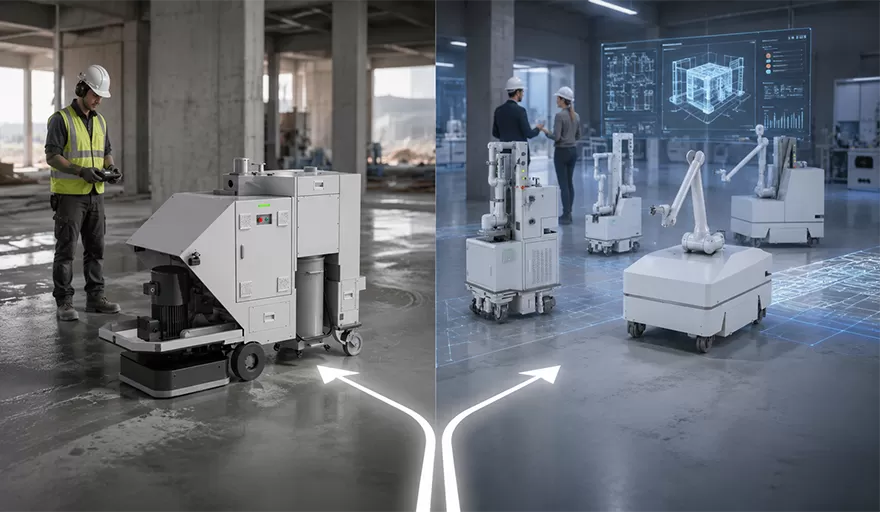
Pioneering Application in Hong Kong is different. It is more suitable when the technology or functional use is new to Hong Kong, involves modification or enhancement, or has strong potential to be shared and replicated across the local construction industry.
In simple terms:
Project Situation | More Suitable CITF Route |
Buying or renting a mature construction robot for a defined project workflow | General Adoption |
Using a robot that is already commercially available and can be matched with a real construction task | General Adoption |
Testing a new-to-Hong-Kong robotic construction method | Pioneering Application |
Modifying or integrating robots with AI, sensors, cloud systems, or new workflows for wider industry demonstration | Pioneering Application |
Building a pilot project that may involve universities, research institutes, or innovation partners | Pioneering Application |
For companies that simply want to adopt construction robots for painting, putty spraying, floor grinding, or tile laying, General Adoption is usually the more practical starting point.
What Is CITF General Adoption?
CITF General Adoption supports the procurement or rental of advanced construction technologies for application in local construction projects. Under the CITF framework, Advanced Construction Technologies include areas such as automation and robotics, advanced tools and equipment, digitalisation, sensors and IoT, and other construction technologies.
For construction robots, General Adoption is designed for practical adoption. The applicant already knows what equipment it wants to use, where the robot will be deployed, and what construction process the robot will support.
This route is usually suitable for contractors that want to adopt robots such as:
· Latex Paint Spraying Robot (3.3m) for standard indoor painting
· Putty & Latex Paint Spraying Robot (3.3m) for residential putty and paint workflows
· Latex Paint Spraying Robot (6.2m) for higher public or commercial spaces
· Putty & Latex Paint Spraying Robot (6.2m) for high-wall putty and paint spraying
· Floor Grinding Robot for concrete floor surface preparation
· Tile-Laying Robot for floor tile installation
The core value of General Adoption is that it helps contractors use proven technology in actual construction environments. The application does not need to become a research project. It should clearly explain the product, the construction task, the project scenario, the quotation, and the expected benefits.
What Is CITF Pioneering Application in Hong Kong?
ACT Pioneering Application in Hong Kong is designed for more innovative and exploratory technology adoption.
This route supports the introduction of emerging technologies that have good potential to bring wider benefits to Hong Kong’s construction industry. It may apply when a technology has already been proven outside Hong Kong but is newly adopted for on-site application in Hong Kong. It may also apply when existing technologies in Hong Kong are modified, combined, or enhanced for a new functional use.
Compared with General Adoption, Pioneering Application usually requires a stronger innovation story. The applicant needs to explain why the technology or use case is new to Hong Kong, how it will be tested, what benefits it can bring to the industry, and how the results or experience will be shared with other industry stakeholders.
This route may involve:
· New-to-Hong-Kong construction robot applications
· Robot systems modified for Hong Kong site conditions
· AI, sensor, or cloud-connected enhancements for new construction workflows
· Multi-site trial projects
· Collaboration with local universities, research institutes, or innovation partners
· Industry experience sharing after implementation
· Detailed reports or presentations to demonstrate results
For contractors, this means Pioneering Application is not just a procurement route. It is closer to a pilot innovation project with industry demonstration value.
General Adoption vs Pioneering Application: Key Differences
Comparison Point | General Adoption | Pioneering Application in Hong Kong |
Best for | Mature construction robot procurement or rental | Hong Kong-first or highly innovative technology application |
Main purpose | Adopt a proven technology for real project use | Introduce, modify, or demonstrate an emerging technology |
Product status | Clear product model, quotation, and use case | May involve modification, integration, or new functional use |
Application focus | Practical adoption, eligibility, cost, project usage | Innovation, replicability, industry-wide benefit |
Complexity | Relatively more direct | More complex proposal and evaluation |
Suitable applicant | Contractors, subcontractors, consultants, specialist contractors | Lead applicants with possible research or innovation partners |
Documentation focus | Product information, quotation, project usage plan | Concept proposal, detailed project plan, innovation value, sharing plan |
Best robot scenario | Buying or renting an approved or mature construction robot | Testing a new robotic workflow or enhanced system in Hong Kong |
The most important difference is this: General Adoption focuses on using mature technology, while Pioneering Application focuses on proving a new application in Hong Kong.
When Should Contractors Choose General Adoption?
Contractors should consider General Adoption when the goal is to adopt a construction robot for a defined construction task.
For example, a painting contractor may want to use the Latex Paint Spraying Robot (3.3m) in residential interior projects to improve painting consistency and reduce repetitive manual spraying. This is a practical adoption case.
A contractor working on higher public spaces may want to use the Latex Paint Spraying Robot (6.2m) to support high-wall painting in corridors, lobbies, public buildings, or large interior areas. This is also a practical adoption case.
A flooring contractor may want to use the Floor Grinding Robot for concrete surface preparation in car parks, industrial floors, public buildings, or renovation projects. Again, the goal is clear: use a mature robot to improve an existing workflow.
General Adoption may be suitable when:
· The robot is commercially available.
· The product model is clearly defined.
· The company wants to purchase or rent the robot.
· The robot will be used in a local construction project.
· The expected benefits are practical and measurable.
· The contractor can prepare quotation and technical documents.
· The project does not need to prove a new technology concept.
This route is especially relevant for finishing contractors, painting subcontractors, flooring specialists, tile-laying teams, main contractors, and public construction project participants who want to adopt robotic equipment with a clear construction purpose.
When Should Contractors Consider Pioneering Application?
Pioneering Application may be suitable when the project goes beyond normal equipment adoption.
For example, if a contractor wants to introduce a construction robot workflow that has not been used in Hong Kong before, or wants to modify a robot system for a special Hong Kong site environment, Pioneering Application may be worth reviewing.
This route may also be considered if the contractor plans to combine robots with AI decision-making, sensors, cloud platforms, data analytics, or digital site management systems to create a new workflow with broader industry value.
Pioneering Application may be suitable when:
· The technology or use case is new to Hong Kong.
· The project requires modification, combination, or enhancement of existing technology.
· The application can benefit more than one company or project.
· The contractor can demonstrate industry-wide replicability.
· The applicant can prepare a more detailed proposal.
· The project may involve universities, research institutes, or technology partners.
· The applicant is willing to share results or experience with industry stakeholders.
However, Pioneering Application should not be selected only because it may have a higher funding ceiling. If the project is simply about buying or renting a mature construction robot, General Adoption is usually more appropriate.
How to Decide: A Practical Route Selection Checklist
Before choosing between General Adoption and Pioneering Application, contractors can use the following checklist.
1. Is the robot already a defined product?
If the robot has a clear product model, quotation, product information, and application scenario, General Adoption is usually the first route to review.
If the robot needs major modification, software enhancement, system integration, or new functional development for Hong Kong, Pioneering Application may be considered.
2. Is the purpose procurement or pilot innovation?
If the purpose is to buy or rent a robot for project use, General Adoption is more practical.
If the purpose is to demonstrate a new construction robot application in Hong Kong, Pioneering Application may be more suitable.
3. Can the benefits be explained through normal construction outcomes?
Benefits such as improved productivity, reduced manual workload, better consistency, fewer rework risks, and safer operation fit well with General Adoption.
Benefits such as industry-wide replicability, new technology transfer, new local use cases, or demonstration value may support Pioneering Application.
4. Does the project need external innovation partners?
General Adoption usually focuses on the applicant’s own construction project and selected product.
Pioneering Application may involve collaboration with universities, research institutes, innovation centres, or technology partners, especially when the project includes development, modification, or demonstration elements.
5. How quickly does the contractor need deployment?
If the contractor wants to deploy a robot for a near-term construction project, General Adoption is usually easier to manage.
If the contractor has enough time to prepare a concept proposal, detailed project plan, technical presentation, and benefit-sharing arrangement, Pioneering Application may be possible.
Product Selection: Which Legend Robot Products Fit General Adoption?
Legend Robot’s six construction robot products are mainly aligned with practical construction workflows, making them suitable for contractors reviewing the General Adoption route.
For residential interior finishing, the Latex Paint Spraying Robot (3.3m) supports standard latex paint spraying, while the Putty & Latex Paint Spraying Robot (3.3m) supports wall base treatment and finishing workflows.
For public construction and large interior spaces, the Latex Paint Spraying Robot (6.2m) and Putty & Latex Paint Spraying Robot (6.2m) are more suitable for higher wall applications, commercial spaces, corridors, lobbies, and public buildings.
For floor finishing workflows, the Floor Grinding Robot supports concrete floor grinding and surface preparation, while the Tile-Laying Robot supports automated floor tile installation.
A contractor preparing a General Adoption application should connect the product with a clear construction task. The application should not only say “we want to use a robot.” It should explain why the selected robot fits the project, what workflow it supports, and what practical benefits it can bring.
Could Legend Robot Products Be Used in a Pioneering Application?
Yes, but only under the right conditions.
A mature robot product itself does not automatically make a project “pioneering.” To fit Pioneering Application, the project usually needs a new-to-Hong-Kong technology use, modification, combination, enhancement, or wider industry demonstration value.
For example, a contractor may consider Pioneering Application if it plans to:
· Combine multiple construction robots into a coordinated digital construction workflow
· Integrate robot deployment with AI-based site planning or cloud-based management
· Modify a robot for a special local project environment
· Test robot-assisted finishing across multiple project types and share results with the industry
· Collaborate with a local research institution to evaluate productivity, safety, and quality outcomes
In this case, the product is only one part of the application. The project proposal must also explain the innovation, implementation plan, measurable outcomes, replicability, and experience-sharing arrangement.
Common Mistakes Contractors Should Avoid
The first mistake is choosing Pioneering Application only because it sounds more advanced. If the project is a normal robot procurement or rental case, General Adoption is usually more suitable.
The second mistake is assuming General Adoption means automatic approval. Even when a product appears on a pre-approved list, each application is still subject to CITF’s latest rules, review process, quotation requirements, and approval conditions.
The third mistake is buying or paying too early. Contractors should review the latest CITF requirements and application timing before signing contracts, placing orders, or making payments.
The fourth mistake is focusing only on the subsidy amount. A strong application should explain real project value, such as improved productivity, better workmanship consistency, safer operation, reduced repetitive labour, and better deployment planning.
The fifth mistake is ignoring training and support. Construction robot adoption requires operator training, workflow coordination, maintenance planning, and after-sales service. These factors can affect whether the robot is successfully used on site.
Recommended Strategy for Hong Kong Contractors
For most contractors, the recommended strategy is to start with General Adoption.
This allows the company to adopt a mature robot for a practical workflow, build internal operation experience, train staff, and collect real project feedback. After the company becomes familiar with robot-assisted construction, it can consider more advanced deployment models.
A staged strategy may look like this:
1. Start with one clear robot workflow, such as painting, putty spraying, floor grinding, or tile laying.
2. Apply under General Adoption if the project fits mature procurement or rental.
3. Train operators and deploy the robot in a real project.
4. Record productivity, quality, safety, and workflow feedback.
5. Expand to more robots or more project scenarios.
6. Consider Pioneering Application later if the company develops a new, replicable, Hong Kong-first robotic construction workflow.
This approach is more realistic than trying to make the first project overly complex.
Conclusion: Choose the Funding Route That Matches Your Real Goal
CITF General Adoption and Pioneering Application both support innovation in Hong Kong’s construction industry, but they are not the same.
General Adoption is more suitable for contractors that want to purchase or rent mature construction robots for real project use. It is practical, product-focused, and closely linked to construction productivity, safety, quality, and workflow improvement.
Pioneering Application is more suitable for projects that introduce, modify, or demonstrate a new technology application in Hong Kong. It requires a stronger innovation proposal, broader industry value, and often a more collaborative project structure.
For companies planning to adopt painting robots, putty spraying robots, floor grinding robots, or tile-laying robots, the best starting point is to define the construction workflow, select the right robot, confirm the latest CITF requirements, and choose the funding route that matches the real project objective.
Founded in 2021, Legend Robot Technology specializes in the R&D and manufacturing of construction robots. With a product portfolio covering residential and public construction scenarios, Legend Robot provides intelligent construction equipment for paint spraying, putty spraying, tile laying, and floor grinding. Through R&D, manufacturing, training, and after-sales service, Legend Robot helps contractors evaluate suitable robot models and deploy robotic construction workflows more smoothly in real projects.
FAQ
Q: What is the main difference between CITF General Adoption and Pioneering Application?
A: General Adoption is mainly for mature technology procurement or rental, while Pioneering Application is for Hong Kong-first, modified, or highly innovative technology applications with wider industry demonstration value.
Q: Which route should contractors choose for mature construction robots?
A: For defined robot models used in real construction workflows, General Adoption is usually the first route to review.
Q: When is Pioneering Application more suitable?
A: It is more suitable when the project introduces a new-to-Hong Kong application, technology modification, system integration, or a replicable innovation case that can benefit the wider industry.
Q: Can the same robot be part of a Pioneering Application?
A: Yes, but only if the project goes beyond ordinary procurement and includes a new workflow, integration approach, or industry demonstration value.
Q: Should the funding route be decided before preparing documents?
A: Yes. The chosen route affects proposal depth, quotation preparation, supporting materials, timeline, and application strategy.
References
1. Construction Innovation and Technology Fund (CITF) — General Application
https://www.citf.cic.hk/?route=funding&funding=2&lang=3
2. Construction Innovation and Technology Fund (CITF) — Pioneering Application in Hong Kong
https://www.citf.cic.hk/?route=funding&funding=3&lang=3
3. Construction Innovation and Technology Fund (CITF) — Advanced Construction Technologies (ACT)
https://www.citf.cic.hk/?route=funding_list&funding=5&lang=1
4. Construction Innovation and Technology Fund (CITF) — Pre-approved Technologies List / Technology Search
https://citf.cic.hk/?route=search-key&lang=1
5. Construction Innovation and Technology Fund (CITF) — Application Procedures
https://www.citf.cic.hk/?lang=1&route=procedure
6. Construction Innovation and Technology Fund (CITF) — FAQ
https://www.citf.cic.hk/?route=faq