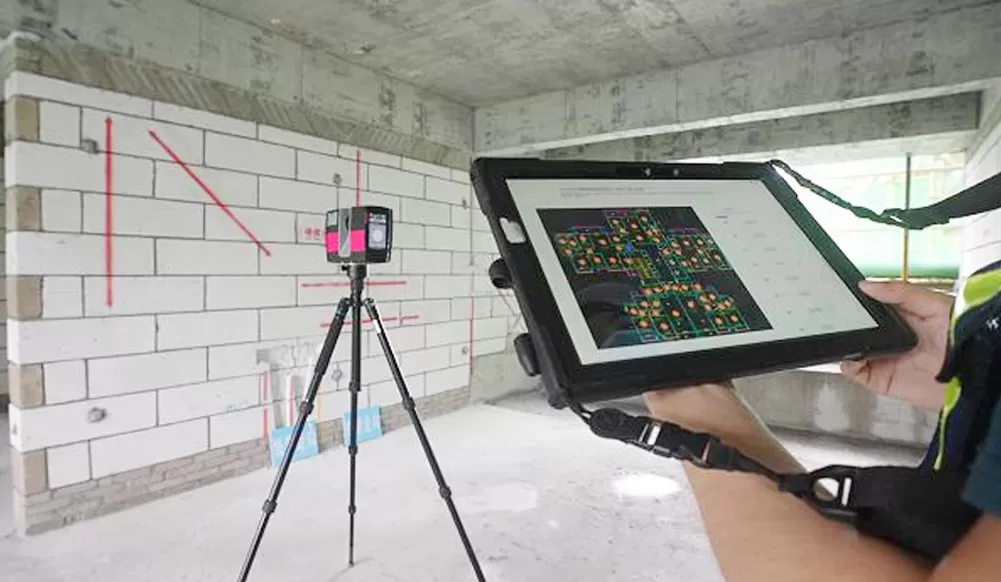
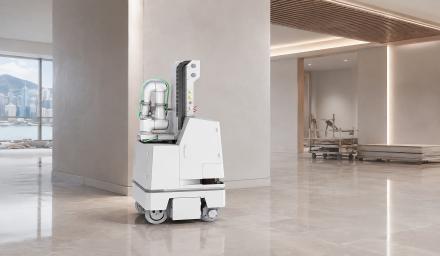
Construction sites often have limited or unreliable GPS availability, especially indoors, underground, or in tunnel-like spaces. However, construction robots still need to know exactly where they are and what surrounds them. This is where SLAM comes in, enabling a construction robot to build a map while tracking its own position in real time.

What SLAM Actually Does
SLAM stands for Simultaneous Localization and Mapping. It solves a specific problem for any construction robot: a robot needs a map to know where it is, but it needs to know where it is to build that map. SLAM handles both tasks simultaneously.
Two outputs come out of this process:
Localization: the robot's position and orientation within its environment, updated continuously
Mapping: a 2D or 3D representation of the surrounding space, used later for path planning and obstacle avoidance
Inside buildings under construction, SLAM is often a practical way for a construction robot to localize itself. This matters because construction firms are under pressure to do more with fewer skilled workers, a shortage widely reported across the industry. A construction robot that can locate itself and move safely without a person guiding every step is one practical answer to that pressure.
How a SLAM System Is Built
A SLAM system used in a construction robot typically consists of two connected parts.
— The front end processes raw data from LiDAR units or cameras and extracts key features from the surrounding environment. It compares consecutive readings to estimate how the robot has moved between them.
— The back end handles correction. Through a process known as loop closure, the system recognizes when a construction robot has returned to a location it has already mapped and uses that recognition to correct accumulated drift over the course of the work.
Many construction robots combine LiDAR, an inertial measurement unit (IMU), and visual sensors. This sensor fusion helps the system stay stable amid dust, changing lighting, and general clutter on an active job site.
Some systems split this work between the robot and a remote server. The robot itself handles the initial on-site scan, filtering out noise and building a rough point cloud in real time. Heavier processing, such as full modeling or compliance checks against a design file, can then run on cloud infrastructure, since these calculations demand more computing power than a small on-site unit can hold.
SLAM Types Used on Construction Sites
There are several SLAM methods, and different construction robot products may be built around different approaches.
LiDAR SLAM uses laser scanning to build a point cloud. It usually works well in low light or dark areas, such as basements and enclosed spaces. However, it often costs more, and it may be less effective in long, repetitive corridors.
Visual SLAM (vSLAM) uses cameras to capture images and detect visual features. It is often more compact and lower-cost, but it can be affected by lighting changes and by plain surfaces with little texture.
Hybrid SLAM combines LiDAR and visual data. This can improve reliability on construction sites, where conditions may change from one area to another.
In practice, many construction robots use multiple sensors to improve accuracy and reliability. As an innovative company in the construction robotics field, Legend Robot integrates multi-sensor fusion technology to enable real-time localization and navigation, allowing robots to operate efficiently in narrow or obstacle-rich spaces without manual guidance.
Practical Applications of SLAM in Construction Robots
SLAM is used in a variety of tasks in intelligent construction projects. In indoor scenarios, SLAM builds a real-time 3D map and performs localization through multi-sensor fusion, providing foundational support for path planning, dynamic obstacle avoidance, and task execution.
Several Legend Robot products have integrated SLAM technology into construction workflows in innovative ways and continue to demonstrate strong adaptability across different scenarios.
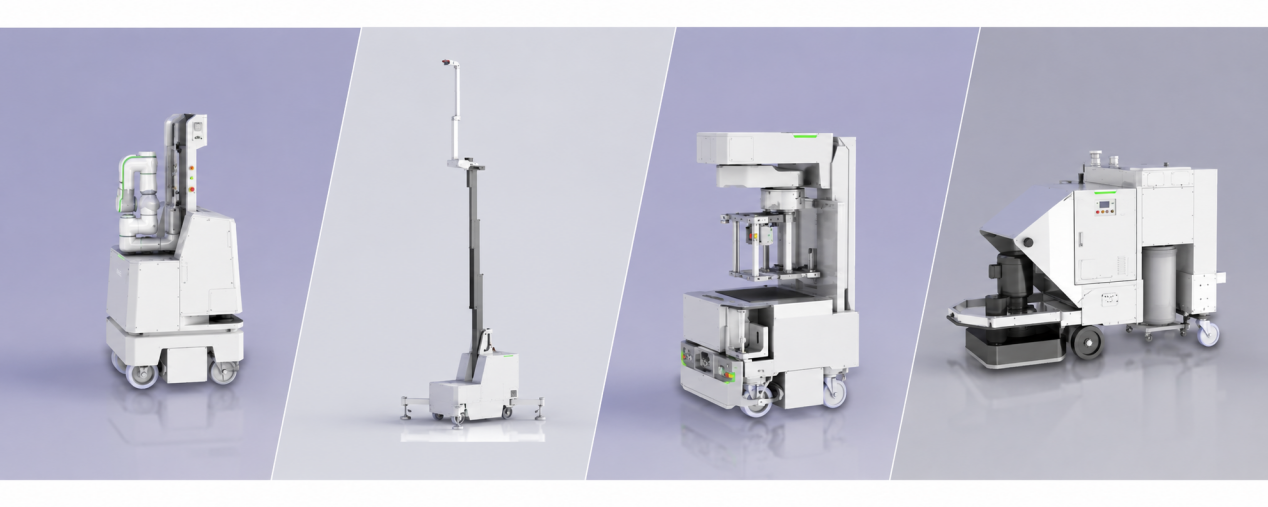
Latex Paint Spraying Robot (3.3m) is equipped with a SLAM navigation system and an omnidirectional chassis. It can move autonomously in narrow residential spaces and cover all feature surfaces, including walls, ceilings, and internal and external corners. Its daily spraying area ranges from 1,200 to 1,500 square meters, with an overall coverage rate exceeding 95%.
Putty Spraying Robot (6.2m) is designed for interior wall coating and putty spraying in public buildings such as factories, hospitals, hotels, and schools. SLAM mapping supports autonomous path planning in large-span spaces. The robot is also equipped with an omnidirectional mobile platform, enabling zero-turning-radius maneuverability. It can easily move through narrow corridors in building spaces that meet international standards. Its putty spraying coverage rate exceeds 80%. The efficiency of the first coat of putty reaches 1,000 to 1,200 square meters per day, while the second coat can reach 1,600 to 2,000 square meters per day.
Tile Laying Robot combines SLAM localization with deep-learning-based visual alignment technology. It controls tile joint deviation within ±0.1 mm and flatness deviation within ≤1 mm. Its daily tile laying capacity is equivalent to that of 6 to 8 skilled workers.
Floor Grinding Robot uses SLAM to build a spatial model and plan grinding paths, achieving a grinding coverage rate of over 95%. For example, it can intelligently detect features such as fire hydrants and columns, and apply a wraparound grinding strategy to ensure precise grinding while avoiding over-grinding.
Project Outcomes and Value: Real-World Project Cases
SLAM-driven construction robots can generate measurable business value in three key areas: shortening construction schedules, reducing labor costs, and improving construction quality.
Legend Robot’s self-developed putty spraying robot and latex paint spraying robot undertook the interior wall finishing work for a 5-story building with 24 residential units, covering a total area of 5,000 square meters.
Results: All wall finishing work was completed within 30 hours, achieving five times the efficiency of manual work. With zero rework, the project delivered high efficiency and quality, and received strong praise from both the developer and the owner.

This project is located in the core area of Nantong and includes three residential buildings: Buildings 12, 16, and 17.
Results: 8 painting robots worked together with 16 technicians to complete the equivalent workload of 135 workers in 60 days within just 45 days. Construction efficiency increased by more than 300%, while total costs were reduced by approximately 40%.

Conclusion
SLAM has become an important foundational capability for the practical deployment of construction robots. It affects not only robot localization and mapping but also directly relates to navigation stability and operational consistency in complex jobsite environments. For repetitive tasks such as spraying, tile laying, and grinding, SLAM can help robots adapt more effectively to construction environments and improve work efficiency and quality control.
As demand for construction automation continues to grow, the value of SLAM will become more evident in more application scenarios. To further understand how construction robots can be applied to specific construction tasks and to evaluate robot solutions suitable for your project, please get in touch with Legend Robot.