A spray painting robot fleet should be sized from the project's sprayable area, available painting days, wall height, room-release sequence and measured effective output per robot. The most reliable approach is to start with manufacturer-rated capacity, run a project mock-up, calculate the percentage of the shift spent actively spraying, and then use that site-specific output to determine robot quantity. This avoids both under-sizing, which threatens the schedule, and over-sizing, which creates idle equipment.
Start with the Project's Real Sprayable Area
Gross floor area is not a useful capacity number for robotic painting. Contractors need the actual surface area that will be sprayed. For apartments and hotels, this usually means wall and ceiling areas by unit type. For schools, hospitals and public buildings, it may be more practical to measure by floor, corridor, room group or functional zone.
A spray painting robot should be assigned only to surfaces that are physically accessible and ready for coating. Openings, fixed casework, protected finishes, unfinished substrate repairs and areas reserved for another coating system should be removed from the workload calculation.
The result is a spray-area schedule: total area by zone, planned release date, required completion date and material system. This document becomes the basis for fleet sizing.
Use Rated Capacity as a Starting Point, Then Validate It
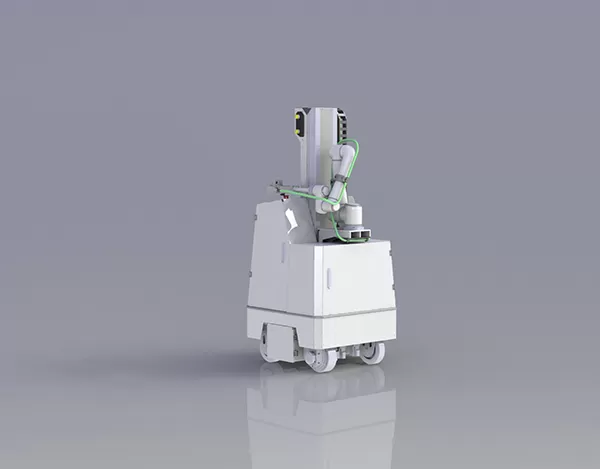
Legend Robot publishes 230 m²/h spraying efficiency, 95% coverage and 1,200-1,500 m²/day for its 3.3m latex paint model. Its 6.2m latex paint model is positioned for high-rise residential and commercial interiors with 95%+ painting coverage and 2,400-3,000 m²/day.
These figures are useful capacity references, but a project should not simply multiply them by the number of days. Effective production depends on room turnover, refill frequency, masking, inspection, relocation, elevator access and interference from other trades.
During a mock-up, record active spraying minutes, relocation minutes, refill time, waiting time and quality rework. Then calculate effective daily output = completed accepted area / total shift. This accepted-area metric is more useful than raw nozzle-on time because it reflects the real construction process.
A Simple Fleet-Sizing Formula for Contractors
Once effective output is known, the core calculation is straightforward:
Required robots = Total sprayable area / (Effective accepted area per robot per day x Available spraying days)
For example, if a project has several repeated apartment towers, the calculation should be done by tower or floor package rather than for the entire development at once. This exposes bottlenecks such as late handover of one tower, insufficient material staging, or limited elevator capacity.
Fleet sizing should also reflect parallel workfaces. A project may mathematically need four robots, but if only two floors can be released at the same time, four units may not improve completion speed. In that case, the constraint is workface availability rather than robotic capacity.
Match Robot Reach to Building Type Before Adding More Units
Decision Point | 3.3m Latex Paint Robot | 6.2m Latex Paint Robot | Why It Matters | Planning Action |
Primary environments | Residential, apartments, hotels, offices | High-rise residential and commercial interiors | Different room and wall-height patterns | Segment work by building zone |
Published daily output | 1,200-1,500 m²/day | 2,400-3,000 m²/day | Capacity differs by robot and scenario | Validate through site mock-up |
Coverage | 95% | 95%+ | Shows large-area automation potential | Plan manual exceptions separately |
Operator model | Up to 3 robots per operator | Up to 3 robots per operator | Changes crew structure | Plan refill, relocation and QC roles |
For standard rooms, the 3.3m platform is usually the more direct fit, while a high-wall latex paint spraying robot can be assigned to taller spaces where additional reach is required. Fleet planning should therefore begin with a height map of the building, not with a single project-wide robot count.
Do Material Workflow and Surface Preparation Affect Fleet Size?
Yes. A fast spray fleet can still wait if coating preparation and wall readiness cannot keep pace. The robot program should therefore be synchronized with paint mixing, filtration, transfer, refill points and surface acceptance.
Where the same contractor controls wall preparation and final coating, a putty and latex paint spraying robot can help link the preparation and coating workflow on one robotic platform. This can simplify planning in repetitive interior projects because the same digital work zones can be used across multiple finishing stages.
Material compatibility should also be confirmed during the mock-up. Nozzle selection, pressure, viscosity, dilution and coating behavior can influence finish quality and working speed. The goal is to establish a repeatable approved setup before full production begins.
FAQ: Spray Painting Robot Fleet Planning
Q1: Is one large robot always better than several compact robots?
A1: No. Reach, access, room size, relocation paths and parallel workfaces matter as much as nominal output. Compact robots may be more flexible in standard rooms, while high-reach models can be better for taller spaces.
Q2: What data should be collected during the first mock-up?
A2: Record accepted spray area, active spraying time, refill time, relocation time, waiting time, material consumption, defects and manual touch-up. These data show whether the constraint is the robot, the workface or the supporting process.
Q3: How should safety be included in fleet planning?
A3: Robotic deployment still requires controlled work zones, ventilation, material handling procedures and human-robot interaction rules. OSHA identifies spray operations as activities with physical and health hazards, while NIOSH notes that construction robots introduce new safety considerations in changing jobsite environments.
Conclusion
A spray painting robot fleet should be sized from accepted output and available workfaces, not from a brochure maximum alone. By measuring real sprayable area, validating a mock-up, matching robot reach to building zones and coordinating material supply with wall readiness, contractors can build a fleet plan that supports the schedule without unnecessary idle capacity.



.png "Grinding Robot for Concrete Floors: How to Plan Coverage, Dust Collection and Disc Selection Before Deployment")