For Hong Kong contractors exploring CITF-supported construction robot adoption, paint and putty spraying robots are among the most practical starting points. Wall and ceiling finishing work is repetitive, labour-intensive, quality-sensitive, and closely linked to project delivery schedules. When the same finishing tasks appear across many rooms, floors, corridors, or public areas, robotic spraying can help contractors improve workflow consistency and reduce the physical burden on workers.
However, choosing a spraying robot is not just about buying a “painting robot.” Contractors need to decide whether they need latex paint spraying, putty spraying, or both. They also need to choose the right working height. For Legend Robot’s spraying robot lineup, the key choice is often between 3.3m models and 6.2m models.
This guide explains how to choose between 3.3m and 6.2m paint and putty spraying robots for Hong Kong construction projects, how these models fit different project scenarios, and what contractors should consider when preparing a CITF-related application.
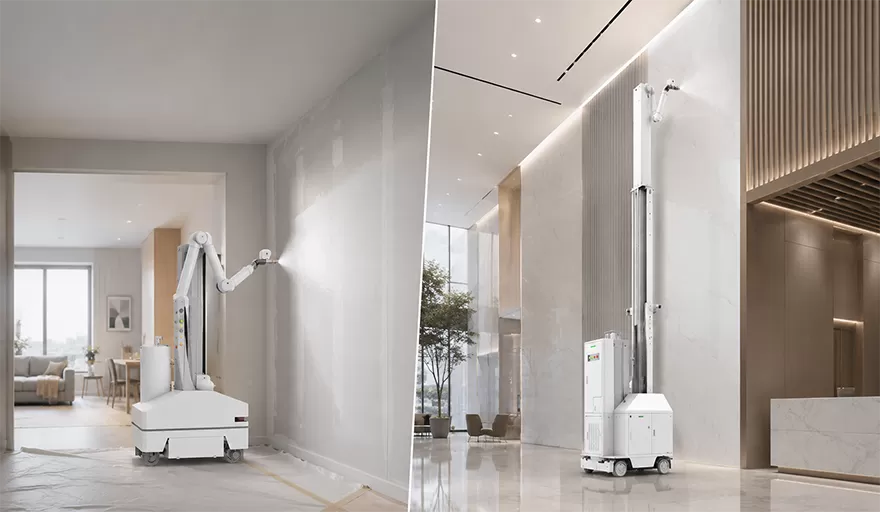
Quick Answer: 3.3m vs 6.2m Spraying Robots
The difference between 3.3m and 6.2m spraying robots is mainly about working height and project scenario.
A 3.3m spraying robot is generally suitable for standard indoor residential and interior finishing projects, such as apartments, residential units, offices, and regular floor-height spaces.
A 6.2m spraying robot is more suitable for higher walls and larger indoor spaces, such as public buildings, commercial lobbies, corridors, halls, institutional buildings, and other high-wall construction environments.
For most contractors, the selection logic is simple: choose the model based on working height, construction stage, project type, and site readiness.
Why Paint and Putty Spraying Robots Are Relevant to Hong Kong Projects
Painting and putty application are common finishing tasks in both residential and public construction projects. These works often involve repeated wall and ceiling surfaces, strict quality requirements, and tight construction schedules.
Traditional manual spraying depends heavily on worker skill, physical endurance, site access, and team coordination. In large projects, inconsistent technique or worker fatigue may lead to uneven coating, rework, slower progress, and higher management difficulty.
Spraying robots can help address these issues by supporting more standardized, planned, and repeatable finishing workflows. They are especially relevant when the project has:
· Repeated room layouts
· Large wall or ceiling areas
· Standardized finishing requirements
· Higher walls or public spaces
· Tight delivery schedules
· Labour shortage pressure
· Need for safer high-wall operations
· Need for more consistent spraying results
For Hong Kong contractors preparing for CITF-related adoption, spraying robots are practical because their project value can be clearly explained: they support productivity, quality consistency, safer operation, and reduced repetitive manual workload.
Latex Paint Spraying vs Putty Spraying: What Is the Difference?
Before choosing between 3.3m and 6.2m models, contractors should first understand whether they need latex paint spraying, putty spraying, or both.
Latex Paint Spraying
Latex paint spraying is part of the finishing stage. It is usually applied after wall preparation work has been completed. The key goals are surface coverage, finishing consistency, coating efficiency, and visual quality.
A latex paint spraying robot is suitable when the contractor mainly needs to improve the painting workflow, reduce repetitive manual spraying, and improve consistency across walls and ceilings.
For this need, contractors may consider:
· Latex Paint Spraying Robot (3.3m)
· Latex Paint Spraying Robot (6.2m)
Putty Spraying
Putty spraying is usually part of wall base treatment. It is closer to the preparation stage before final painting. The key goal is to prepare the wall surface for a better finishing result.
A putty spraying robot is suitable when the contractor is responsible for wall preparation, base treatment, and paint finishing. If a project requires both putty and latex paint workflows, a putty and paint spraying model can provide stronger process coverage than a paint-only model.
For this need, contractors may consider:
· Putty & Latex Paint Spraying Robot (3.3m)
· Putty & Latex Paint Spraying Robot (6.2m)
How to Decide
Choose a latex paint spraying robot if your main requirement is final paint application.
Choose a putty and latex paint spraying robot if your project includes wall base treatment and paint spraying, or if you want one robot solution to support more of the wall finishing process.
When Should You Choose a 3.3m Spraying Robot?
A 3.3m spraying robot is designed for standard indoor finishing scenarios. It is suitable for spaces where wall and ceiling height falls within normal indoor project requirements.
Typical applications include:
· Residential apartments
· Private housing projects
· Standard interior rooms
· Offices
· Hotel rooms
· Schools and institutional interiors with regular floor heights
· Batch room painting
· Standard wall putty and paint workflows
For residential projects, the 3.3m models are usually easier to match with repeated room layouts and standard indoor construction processes. In apartment buildings, many units may share similar wall heights, ceiling heights, and finishing requirements. This makes robotic spraying easier to plan and repeat.
Recommended 3.3m Models
The Latex Paint Spraying Robot (3.3m) is suitable for standard indoor latex paint spraying. It can support contractors that focus mainly on paint finishing.
The Putty & Latex Paint Spraying Robot (3.3m) is suitable for projects that require both wall base treatment and paint spraying in standard indoor environments.
Best-fit Customer Types
3.3m spraying robots are especially suitable for:
· Residential contractors
· Interior finishing contractors
· Painting subcontractors
· Renovation contractors
· Apartment finishing teams
· Hotel room renovation teams
· Contractors handling repeated room-based finishing work
Main Advantages of 3.3m Models
The main advantage of 3.3m models is fit. They are designed for standard indoor scenarios, making them practical for residential and common interior construction projects.
They also help contractors build robotic construction experience in a relatively controlled environment. Compared with large public spaces, standard rooms are often easier to measure, plan, protect, and coordinate.
For contractors applying for CITF funding, a 3.3m spraying robot application should clearly explain the project type, number of units or rooms, wall and ceiling scope, spraying workflow, and expected benefits.
When Should You Choose a 6.2m Spraying Robot?
A 6.2m spraying robot is more suitable for high-wall and large-space construction scenarios. It is designed for projects where standard indoor equipment may not provide enough working height.
Typical applications include:
· Public buildings
· Commercial lobbies
· Large corridors
· High-wall interiors
· Shopping mall spaces
· Institutional buildings
· Hospitals and transport-related spaces
· Public facility renovation
· Large open indoor spaces
In these environments, manual spraying may require more elevated work arrangements, more site coordination, and more safety planning. A 6.2m spraying robot can help contractors reduce reliance on long-duration manual high-wall spraying and create a more standardized approach to finishing large vertical surfaces.
Recommended 6.2m Models
The Latex Paint Spraying Robot (6.2m) is suitable for high-wall latex paint spraying in public and commercial spaces.
The Putty & Latex Paint Spraying Robot (6.2m) is suitable for high-wall putty and paint workflows where wall base treatment and finishing need to be planned together.
Best-fit Customer Types
6.2m spraying robots are especially suitable for:
· Main contractors
· Public construction contractors
· Commercial building contractors
· Large-scale interior finishing teams
· Painting contractors working in high spaces
· Contractors responsible for lobbies, corridors, halls, and public areas
· Renovation teams handling large public buildings
Main Advantages of 6.2m Models
The main advantage of 6.2m models is height coverage. For high-wall projects, the right working height can directly affect deployment efficiency, safety planning, and finishing consistency.
For CITF-related applications, contractors should explain why a high-wall robot is necessary. The application can describe the working height, project environment, wall area, safety considerations, manual access challenges, and expected productivity improvement.
3.3m vs 6.2m: Detailed Comparison
Comparison Factor | 3.3m Spraying Robots | 6.2m Spraying Robots |
Best project type | Residential and standard interior projects | Public, commercial, and large-space projects |
Typical working area | Standard walls and ceilings | High walls, lobbies, corridors, halls |
Main use case | Batch indoor room finishing | High-wall and large-area finishing |
Suitable construction stage | Putty spraying, latex paint spraying, or both | High-wall putty spraying, latex paint spraying, or both |
Site complexity | Usually easier to plan in repeated rooms | Requires more site coordination and access planning |
Customer type | Residential contractors, interior finishing teams, painting subcontractors | Main contractors, public project contractors, commercial finishing teams |
CITF application focus | Repeated room workflow, productivity, consistency | High-wall operation, safety, productivity, large-area deployment |
First-adoption suitability | Good for contractors starting with standard indoor spraying | Good for contractors with public or high-wall project demand |
The best choice is not necessarily the larger model. A 6.2m robot is not automatically better than a 3.3m robot. The best choice is the model that fits the project height and workflow.
How to Choose Between Paint-only and Putty + Paint Models
The second major decision is whether to choose a paint-only robot or a putty and paint robot.
A paint-only robot is suitable when the contractor mainly needs to improve the final coating stage. This may be enough for teams that already have a separate wall preparation process or only want to automate painting.
A putty and paint robot is suitable when the contractor wants to support more of the wall finishing workflow. This can be useful when one team is responsible for both wall preparation and final paint spraying.
A practical decision table is shown below:
How CITF Funding Affects Spraying Robot Selection
CITF can make construction robot adoption more practical by reducing the financial burden of procurement or rental. For contractors considering spraying robots, this means the product selection should be connected with the funding application strategy from the beginning.
Under CITF’s Advanced Construction Technologies framework, automation and robotics are included within the technology adoption scope. General Adoption generally supports procurement and rental of advanced technologies for local projects on a matching basis, subject to the latest CITF requirements, procurement procedures, approved product price, and application review.
For spraying robot applications, contractors should prepare a clear explanation of:
· Why the selected robot is needed
· Which project it will support
· Whether the robot is for latex paint, putty, or both
· Why the working height is suitable
· How many rooms, walls, floors, or areas may be involved
· What productivity, safety, or quality benefits are expected
· How operators will be trained
· How on-site deployment will be managed
· What documents, photos, or usage evidence can be kept
A strong CITF-related application should not only mention that the robot is innovative. It should connect the robot with real project value.
Application Example: Residential Painting Project
A residential contractor working on repeated apartment interiors may choose the Latex Paint Spraying Robot (3.3m) if the main requirement is final paint spraying.
In the CITF-related application, the contractor can explain that the robot will support standard indoor wall and ceiling spraying across repeated residential units. The expected value may include improved spraying consistency, reduced manual workload, better workflow planning, and more standardized finishing quality.
If the contractor is also responsible for wall base treatment, the Putty & Latex Paint Spraying Robot (3.3m) may be more suitable because it can support a broader wall finishing workflow.
Application Example: Public Building High-wall Project
A contractor working on public building interiors, large corridors, or high-wall commercial areas may choose the Latex Paint Spraying Robot (6.2m) if the project mainly involves paint spraying.
If the project also requires high-wall putty spraying before painting, the Putty & Latex Paint Spraying Robot (6.2m) may be more appropriate.
In the CITF-related application, the contractor can emphasize the height of the work area, large wall surface, safety considerations, productivity improvement, and reduced dependency on long-duration manual elevated work.
Site Conditions to Check Before Deploying Spraying Robots
Before choosing a spraying robot, contractors should confirm whether the site is ready for robotic deployment.
For standard indoor projects, contractors should check:
· Room size and layout
· Wall and ceiling accessibility
· Power supply
· Material supply arrangement
· Masking and surface protection
· Ventilation
· Worker movement routes
· Coordination with other trades
For high-wall projects, contractors should additionally check:
· Working height
· Open floor area
· Obstacle clearance
· Access route
· Safety zoning
· Material handling
· Ceiling and wall interface conditions
· Whether the robot can be positioned efficiently
Site readiness affects both productivity and application credibility. If the site conditions are unclear, the robot may be difficult to deploy smoothly even if the product itself is suitable.
Common Mistakes When Choosing Spraying Robots
The first mistake is choosing a 6.2m model only because it looks more capable. If the project mainly involves standard residential interiors, a 3.3m model may be more practical.
The second mistake is choosing a paint-only robot when the project actually requires both putty and paint workflows. Contractors should review the full finishing process before selecting a model.
The third mistake is ignoring site access. Even the right robot needs suitable movement space, power, material supply, and protection arrangements.
The fourth mistake is preparing a weak CITF application. The application should explain the project need, construction workflow, expected benefits, and deployment plan, not only the robot’s product name.
The fifth mistake is assuming funding approval is guaranteed. Contractors should always check the latest CITF rules, Pre-approved Technologies List, Approved Product Price, application procedures, and documentation requirements.
The sixth mistake is underestimating training. Spraying robot success depends on trained operators, proper material preparation, workflow planning, and responsive after-sales support.
Recommended Selection Framework
Contractors can follow this simple framework before choosing a spraying robot:
Step 1: Define the construction stage
Is the project mainly latex paint spraying, putty spraying, or both?
Step 2: Confirm the working height
Is the site a standard indoor space or a high-wall public/commercial space?
Step 3: Match the project type
Is it residential, commercial, public, renovation, hotel, institutional, or mixed-use?
Step 4: Estimate the work area
How many rooms, walls, floors, or zones will the robot support?
Step 5: Check CITF suitability
Confirm the latest CITF funding route, Pre-approved Technologies List, approved product information, quotation requirements, and application timing.
Step 6: Plan deployment
Confirm operator training, site readiness, material supply, safety planning, and documentation.
By following this framework, contractors can choose a robot based on real project needs rather than model size alone.
Conclusion: Choose by Height, Workflow, and Project Value
For Hong Kong contractors, paint and putty spraying robots can be a practical entry point into construction automation. They support common finishing tasks, reduce repetitive manual workload, improve process consistency, and help contractors build experience with robotic construction workflows.
The key is choosing the right model.
Choose a 3.3m spraying robot for standard indoor residential and interior finishing projects. Choose a 6.2m spraying robot for high-wall public, commercial, and large-space projects. Choose a latex paint spraying robot when the main need is final coating. Choose a putty and latex paint spraying robot when the project includes both wall base treatment and paint finishing.
For CITF-related adoption, contractors should prepare early, check the latest official requirements, match the robot with a real project workflow, and avoid making procurement or payment decisions before completing the proper application planning.
Founded in 2021, Legend Robot Technology specializes in the R&D and manufacturing of construction robots. With spraying robot models for both residential and public construction scenarios, Legend Robot supports contractors in selecting suitable equipment, planning on-site deployment, training operators, and building smarter construction workflows for Hong Kong projects.
FAQ
Q: What is the main difference between 3.3m and 6.2m spraying robots?
A: A 3.3m spraying robot is generally suitable for standard indoor residential and interior spaces, while a 6.2m spraying robot is designed for high-wall public or commercial spaces.
Q: When should contractors choose a latex paint spraying robot?
A: Choose a latex paint spraying robot when the main task is final paint application and wall preparation is already handled separately.
Q: When should contractors choose a putty and latex paint spraying robot?
A: Choose a putty and latex paint spraying robot when the project includes both wall base treatment and final paint spraying.
Q: Can paint and putty spraying robots be considered for CITF funding?
A: Eligible robotic technologies may be considered under CITF's Advanced Construction Technologies scheme, subject to the latest rules, product listing, and application approval.
Q: What should contractors include in a spraying robot application?
A: Include working height, wall or ceiling area, project type, spraying process, site readiness, operator training, expected benefits, and quotation documents.
References
1. Construction Innovation and Technology Fund (CITF) — General Application
https://www.citf.cic.hk/?route=funding&funding=2&lang=3
2. Construction Innovation and Technology Fund (CITF) — Pre-approved Technologies List / Technology Search
https://citf.cic.hk/?route=search-key&lang=1
3. Construction Innovation and Technology Fund (CITF) — Application Procedures
https://www.citf.cic.hk/?lang=1&route=procedure
4. Construction Innovation and Technology Fund (CITF) — FAQ
https://www.citf.cic.hk/?route=faq