Choosing the right construction robot is not only a product decision. For Hong Kong contractors, it is also a project planning decision, a workflow decision, and in many cases, a CITF funding preparation decision.
As Hong Kong continues to promote smart construction, automation, and construction robot adoption, contractors are paying more attention to how robots can be used in real projects. However, many companies still face the same question: Which construction robot should we choose first?
The answer depends on several practical factors, including project type, working height, construction stage, floor area, labour arrangement, site readiness, and whether the robot will be purchased, rented, or adopted through a CITF-related application.
This guide compares different types of construction robots for Hong Kong residential, commercial, and public construction projects, and explains how contractors can select the most suitable robot based on actual site needs.
Quick Answer: Choose the Robot by Construction Workflow First
The fastest way to choose a construction robot is to start from the construction workflow, not from the robot model.
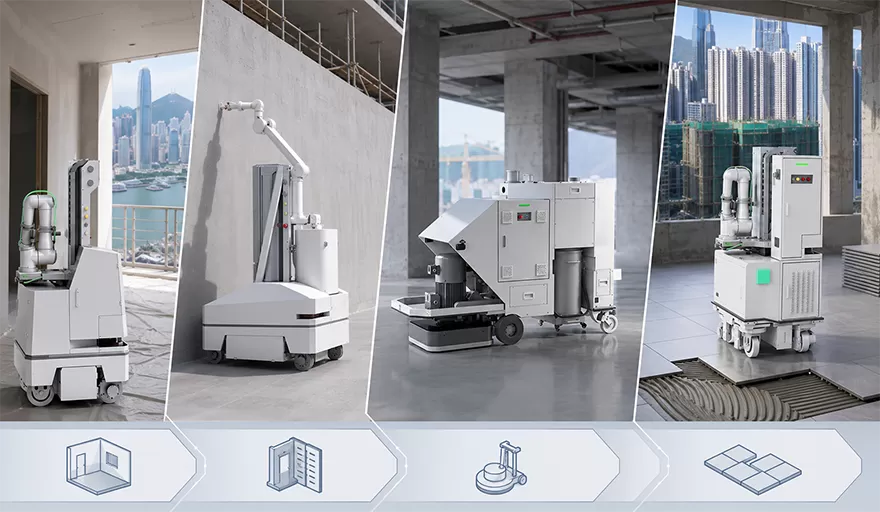
If your project needs indoor wall painting, choose a paint spraying robot. If your project involves wall base treatment before painting, choose a putty and paint spraying robot. If your project involves concrete floor surface preparation, choose a floor grinding robot. If your project needs large-area floor tile installation, choose a tile-laying robot.
A practical selection table is shown below:
Construction Need | Recommended Robot | Suitable Project Type |
Standard indoor wall and ceiling painting | Latex Paint Spraying Robot (3.3m) | Residential buildings, apartments, standard interior finishing |
Wall putty and latex paint spraying for standard indoor spaces | Putty & Latex Paint Spraying Robot (3.3m) | Residential interiors, batch room finishing, wall base treatment |
High-wall latex paint spraying | Latex Paint Spraying Robot (6.2m) | Public buildings, commercial spaces, lobbies, corridors |
High-wall putty and latex paint spraying | Putty & Latex Paint Spraying Robot (6.2m) | Public construction, large interiors, high-wall finishing |
Concrete floor grinding and surface preparation | Floor Grinding Robot | Car parks, industrial floors, public buildings, renovation projects |
Automated floor tile installation | Tile-Laying Robot | Residential and commercial tiling, large-area repetitive floor layouts |
For most contractors, the best first robot is the one that solves the most repetitive, labour-intensive, quality-sensitive, or safety-sensitive task in their current projects.
Why Robot Selection Matters in Hong Kong Construction Projects
Construction robots can help contractors improve productivity, reduce repetitive manual work, enhance quality consistency, and support safer site operations. However, these benefits only appear when the right robot is used in the right construction scenario.
A robot that performs well in one project may not be the best choice for another project. For example, a standard indoor painting robot may be suitable for residential units but not enough for high-wall public spaces. A floor grinding robot may create strong value in car parks and industrial floors, but it is not the right tool for tile installation. A tile-laying robot can support repetitive tiling work, but it should be deployed where floor layout, access, and site preparation are suitable.
For Hong Kong projects, robot selection is especially important because site conditions can be complex. Contractors may need to consider limited working space, multiple subcontractors working at the same time, tight schedules, vertical transportation, safety rules, and the need to keep proper records for project reporting or CITF-related follow-up.
A good robot selection plan should answer four questions:
1. What construction task will the robot perform?
2. Where will the robot be used on site?
3. What project benefit is expected?
4. How will the contractor train workers and manage deployment?
Selection Factor 1: Project Type
The first selection factor is project type. Residential projects and public construction projects often require different robot configurations.
Residential Construction Projects
Residential projects usually involve repeated indoor units, standard floor heights, interior wall finishing, ceiling painting, and floor tile installation. These projects are suitable for robots that can support repetitive finishing tasks in a standardized way.
For residential projects, suitable options include:
· Latex Paint Spraying Robot (3.3m)
· Putty & Latex Paint Spraying Robot (3.3m)
· Tile-Laying Robot
The main value in residential projects is workflow repeatability. When multiple units share similar room layouts, wall dimensions, and finishing requirements, robots can help contractors standardize the process and reduce variation between different workers or teams.
Public and Commercial Construction Projects
Public and commercial construction projects may involve higher walls, larger floor areas, wider corridors, large lobbies, public facilities, car parks, and more complex site coordination. These projects often require robots with greater working height, stronger site adaptability, or higher productivity potential.
For public and large-scale projects, suitable options include:
· Latex Paint Spraying Robot (6.2m)
· Putty & Latex Paint Spraying Robot (6.2m)
· Floor Grinding Robot
The main value in public projects is handling larger, higher, or more repetitive work areas with better consistency and reduced manual burden.
Selection Factor 2: Working Height
Working height is one of the most important factors when choosing a spraying robot.
A 3.3m spraying robot is generally more suitable for standard indoor spaces such as apartments, residential units, offices, and regular room-height interiors. It is easier to match with typical indoor wall and ceiling finishing tasks.
A 6.2m spraying robot is better suited for higher walls and larger spaces. This may include public buildings, commercial lobbies, high corridors, institutional interiors, large halls, and other areas where manual high-wall spraying may require more access equipment, more labour coordination, or longer preparation time.
A simple selection rule is:
· Choose 3.3m models for standard indoor residential and interior finishing projects.
· Choose 6.2m models for public construction, commercial spaces, and higher wall applications.
Working height should be evaluated before quotation and CITF application preparation because it affects product selection, site planning, operator arrangement, and project benefit explanation.
Selection Factor 3: Construction Stage
Different robots fit different construction stages.
Putty Spraying Stage
Putty spraying is usually part of wall base treatment. It helps prepare the wall surface before final finishing. For contractors responsible for wall preparation and painting, a putty and paint spraying robot may provide stronger workflow value than a paint-only robot.
For standard indoor spaces, the Putty & Latex Paint Spraying Robot (3.3m) can support residential wall preparation and finishing. For higher spaces, the Putty & Latex Paint Spraying Robot (6.2m) can support public or commercial wall finishing workflows.
Latex Paint Spraying Stage
Latex paint spraying is part of the finishing stage. It is suitable for contractors focused on coating efficiency, surface consistency, and repetitive wall or ceiling painting.
For standard residential spaces, the Latex Paint Spraying Robot (3.3m) is suitable. For higher walls and public interiors, the Latex Paint Spraying Robot (6.2m) is more relevant.
Floor Grinding Stage
Floor grinding is usually related to concrete floor preparation, surface treatment, renovation, or finishing preparation. The Floor Grinding Robot is suitable for large-area floor projects where manual grinding can be repetitive, physically demanding, and difficult to keep consistent over long working hours.
Typical applications include car parks, industrial floors, public buildings, logistics spaces, and renovation projects.
Tile Laying Stage
Tile laying is a later-stage finishing activity. The Tile-Laying Robot is suitable for projects with repetitive tile installation requirements, especially where layout planning, accuracy, and floor area make automation meaningful.
Typical applications include residential interiors, commercial spaces, public facilities, and large-area floor tiling projects.
Selection Factor 4: Work Area and Repetition
Construction robots are more valuable when the work is repetitive, measurable, and planned in advance.
For example, a painting robot is more useful when multiple rooms, walls, or floors have similar finishing requirements. A floor grinding robot is more effective when the work area is large enough to justify robotic setup and operation. A tile-laying robot works better when the floor layout allows organized tile placement and efficient movement.
Before selecting a robot, contractors should estimate:
· Total wall area
· Total floor area
· Number of rooms or zones
· Height of working surfaces
· Repetition of layout
· Expected working schedule
· Number of workers currently required
· Manual workload intensity
· Quality control difficulty
· Site access and movement conditions
If the task is too small, too irregular, or too fragmented, robot deployment may be less efficient. If the task is large, repetitive, and easy to plan, robotic adoption is more likely to create visible value.
Selection Factor 5: Site Readiness
Robot selection should also consider whether the site is ready for robot operation.
For spraying robots, contractors should check wall accessibility, movement space, material supply, masking requirements, power supply, ventilation, and coordination with other finishing trades.
For the Floor Grinding Robot, contractors should check floor condition, access route, power supply, dust control, obstacle clearance, and whether the work area can be organized for continuous operation.
For the Tile-Laying Robot, contractors should check floor flatness, tile supply arrangement, layout planning, site access, and coordination with manual workers for edge areas or special locations.
Site readiness is also relevant to Hong Kong’s public works environment. The Development Bureau’s Technical Circular on construction robot adoption emphasizes that reasonable site tidiness, clear pathways, organized material storage, and prompt waste removal help ensure safe and efficient robot operation. This is an important reminder for all contractors: robots perform best when the site is prepared for robotic movement and workflow control.
Selection Factor 6: CITF Funding Preparation
For Hong Kong contractors, robot selection should be connected with CITF application preparation from the beginning.
When preparing a CITF-related application, the selected robot should be matched with a clear construction process and project scenario. The application should explain not only the product model, but also the reason for adoption, expected benefits, deployment plan, and project relevance.
A stronger robot selection plan should include:
· Product name and model
· Construction workflow supported by the robot
· Project type and usage scenario
· Expected productivity, quality, or safety benefit
· Training and operator arrangement
· Site preparation requirements
· Quotation and product documentation
· Whether the product appears in the latest CITF Pre-approved Technologies List
· Whether the cost aligns with the latest Approved Product Price, where applicable
For General Adoption applications, this workflow-based explanation is especially important because the application should show how the technology will be applied in local construction projects.
Robot Selection Matrix for Hong Kong Contractors
The following selection matrix can help contractors quickly identify suitable robot types.
Your Project Situation | Recommended Product | Why It Fits |
Standard residential interior painting | Latex Paint Spraying Robot (3.3m) | Matches regular indoor wall and ceiling height |
Residential wall base treatment plus painting | Putty & Latex Paint Spraying Robot (3.3m) | Supports both putty and latex paint workflows |
High-wall public or commercial painting | Latex Paint Spraying Robot (6.2m) | Suitable for higher indoor spaces and large wall areas |
High-wall putty and finishing work | Putty & Latex Paint Spraying Robot (6.2m) | Supports high-wall base treatment and coating |
Large concrete floor preparation | Floor Grinding Robot | Suitable for repetitive floor grinding and surface preparation |
Large-area tile installation | Tile-Laying Robot | Supports repetitive floor tile laying with planned workflow |
Contractor wants to start with one robot | Choose the robot linked to the most repetitive task | Easier to train operators and measure results |
Contractor wants a multi-robot strategy | Combine spraying, grinding, and tile-laying robots by construction stage | Builds a broader smart construction workflow |
Which Robot Should You Choose First?
If your company has never used construction robots before, the best first robot is usually the one with the clearest workflow and easiest benefit measurement.
For painting contractors, a spraying robot is often a practical starting point because the workflow is easy to understand: wall or ceiling area, coating material, working height, and finishing quality.
For flooring contractors, a Floor Grinding Robot may be a strong starting point if the company handles large concrete floor areas, car parks, renovation sites, or industrial flooring projects.
For tiling teams, the Tile-Laying Robot may be suitable if the project includes large-area repetitive tile installation and the site can be prepared for organized robot operation.
For main contractors, the best approach may be to choose robots according to project stage. For example, a public construction project may use a Floor Grinding Robot for floor preparation and a Putty & Latex Paint Spraying Robot (6.2m) for high-wall finishing. A residential project may combine the Putty & Latex Paint Spraying Robot (3.3m) with the Tile-Laying Robot for interior finishing automation.
Common Mistakes When Choosing Construction Robots
The first mistake is choosing by funding potential only. CITF support is important, but the robot must still fit the project workflow. A subsidized robot that does not match the site will not create strong value.
The second mistake is ignoring working height. Choosing a 3.3m model for a high-wall project or a 6.2m model for a small standard interior project may reduce efficiency or increase unnecessary complexity.
The third mistake is treating all spraying robots the same. Putty spraying and latex paint spraying are different construction stages. Contractors should choose according to the actual finishing process.
The fourth mistake is ignoring site readiness. Robots need clear pathways, suitable working zones, power supply, material coordination, and trained operators.
The fifth mistake is failing to prepare usage evidence. For CITF-related adoption, contractors should keep product documents, quotation records, deployment photos, training records, and project usage evidence.
The sixth mistake is underestimating training. Robot adoption is not only a machine purchase. Workers need to learn how to operate, monitor, and coordinate with the robot. Good training improves deployment success.
Recommended Robot Selection Process
Contractors can follow this five-step process:
Step 1: Define the construction task
Identify whether the task is painting, putty spraying, floor grinding, tile laying, or another workflow.
Step 2: Confirm the project scenario
Clarify whether the project is residential, commercial, public, renovation, industrial, or mixed-use.
Step 3: Check working height and work area
For spraying robots, working height is critical. For flooring robots, floor area and movement conditions are critical.
Step 4: Review CITF suitability
Check the latest CITF Pre-approved Technologies List, funding route, approved product information, and application requirements before purchase or rental.
Step 5: Plan deployment and training
Confirm operator arrangement, site readiness, training needs, after-sales support, and documentation requirements.
This process helps contractors choose a robot that is not only technically suitable, but also easier to deploy and explain in a CITF-related application.
Conclusion: The Best Construction Robot Is the One That Fits Your Workflow
There is no single best construction robot for every Hong Kong project. The right choice depends on project type, working height, construction stage, site readiness, and business goals.
For standard residential wall finishing, 3.3m spraying robots are usually more practical. For public buildings and higher spaces, 6.2m spraying robots are more suitable. For floor preparation, a floor grinding robot can support large-area surface treatment. For repetitive tile installation, a tile-laying robot can help automate floor finishing workflows.
For contractors preparing CITF-related applications, the key is to choose the robot based on real construction value: productivity, quality consistency, safer operation, reduced repetitive labour, and better site workflow planning.
Founded in 2021, Legend Robot Technology specializes in the R&D and manufacturing of construction robots. With products covering residential and public construction scenarios, Legend Robot provides intelligent equipment for paint spraying, putty spraying, tile laying, and floor grinding. Through R&D, manufacturing, training, and after-sales service, Legend Robot helps contractors choose suitable construction robots and deploy smart construction workflows more effectively in Hong Kong projects.
FAQ
Q: How should contractors choose their first construction robot?
A: Contractors should start from the most repetitive, labour-intensive, quality-sensitive, or safety-sensitive workflow, rather than choosing by product name only.
Q: Which robots are better for standard residential interiors?
A: The 3.3m spraying robots and the Tile-Laying Robot are generally better suited to standard indoor spaces, repeated room layouts, and residential finishing workflows.
Q: Which robots are better for public or commercial projects?
A: The 6.2m spraying robots and the Floor Grinding Robot are more suitable for higher walls, larger areas, public buildings, commercial spaces, and large floor preparation work.
Q: Why does working height matter when choosing a spraying robot?
A: Working height affects robot model selection, site planning, safety arrangement, operator workflow, and how the project benefits are explained in a CITF-related application.
Q: Should CITF suitability affect robot selection?
A: Yes. Contractors should check the latest funding route, pre-approved listing, approved product information, quotation rules, and application timing before purchase or rental.
References
1. Construction Innovation and Technology Fund (CITF) — General Application
https://www.citf.cic.hk/?route=funding&funding=2&lang=3
2. Construction Innovation and Technology Fund (CITF) — Pre-approved Technologies List / Technology Search
https://citf.cic.hk/?route=search-key&lang=1
3. Construction Innovation and Technology Fund (CITF) — Application Procedures
https://www.citf.cic.hk/?lang=1&route=procedure