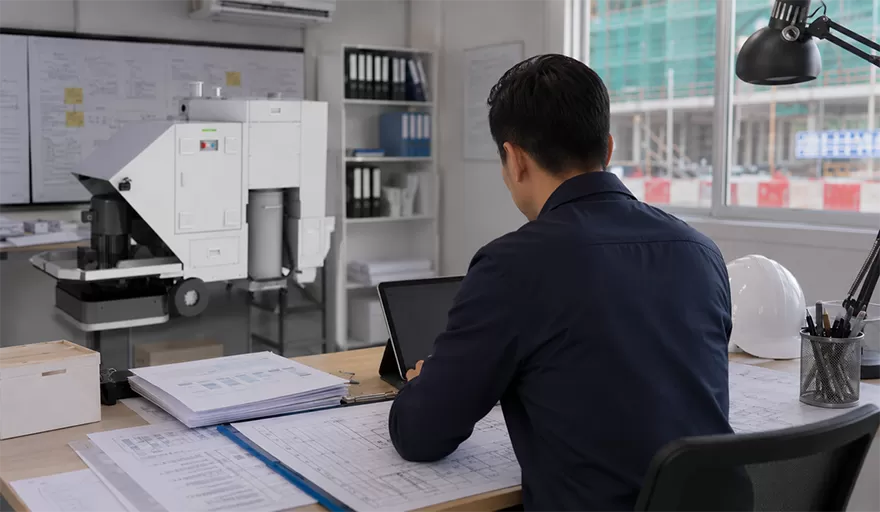
Consistent coating thickness across walls, ceilings, corners, beams, and openings depends on how geometry, motion, and spraying parameters work together. At Legend Robot, our approach links site geometry, path planning under spraying-process constraints, and controlled spray execution.
Our construction robots are configured around defined targets for latex paint and putty. The following sections explain the control logic through the algorithm, product parameters, and project results.
Key Takeaways
Key findings. Controlled spray parameters, a constant spray distance, and intelligent motion algorithms help automatic wall painting robots maintain consistent coating thickness across the wall.
Coating targets. Our latex paint spraying robots (LQ05A and LQ07A) use a 70μm±5μm single-coat target. Our putty spraying robots (LQ00C and LQ06A) are designed to apply a first coat with a thickness of 1.2–1.5 mm and a second coat with a thickness of 0.6–0.9 mm.
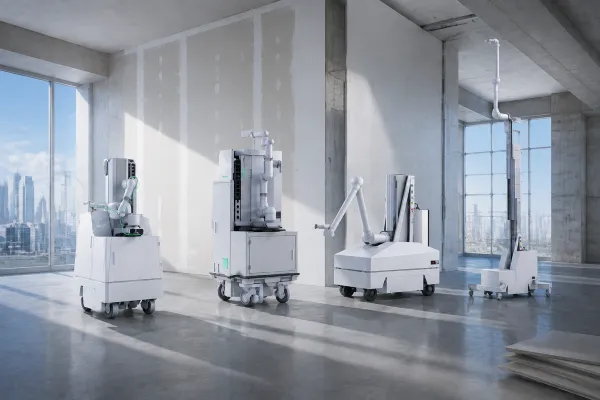
Product recommendation. LQ05A and LQ00C suit standard-height interiors, while LQ07A and LQ06A cover high-wall work. LQ05A and LQ07A serve paint-only scopes, while LQ00C and LQ06A support both putty and latex paint.
Thickness Targets and Product Advantages
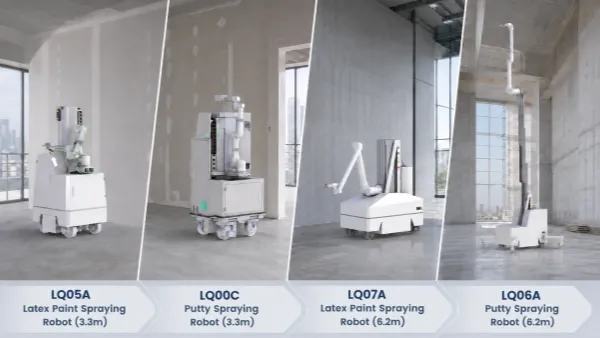
LQ05A and LQ07A share the same single-coat latex paint target, while LQ00C and LQ06A share the same first-coat and second-coat putty ranges.
The LQ05A / LQ00C 3.3 m series and LQ07A / LQ06A 6.2 m series are designed for different working heights and application scopes.
Our Model | Thickness Target | Product Capability |
LQ05A — Latex Paint Spraying Robot (3.3m) | 70μm ± 5μm, single coat | 3.3 m height; over 95% coverage; 1,200-1,500 m2/day |
LQ00C — Putty Spraying Robot (3.3m) | 1.2-1.5 mm first coat; 0.6-0.9 mm second coat | 3.3 m height; over 95% putty coverage; dual-material spraying (putty and latex); 500-600 m2/day first coat; 800-1,000 m2/day second coat |
LQ07A — Latex Paint Spraying Robot (6.2m) | 70μm ± 5μm, single coat | 6.2 m height; over 95% coverage; 2,400-3,000 m2/day; 12 h battery |
LQ06A — Putty Spraying Robot (6.2m) | 1.2-1.5 mm first coat; 0.6-0.9 mm second coat | 6.2 m height; over 95% putty coverage; dual-material spraying (putty and latex); 1,000-1,200 m2/day first coat; 1,600-2,000 m2/day second coat |
How the Algorithm Converts Wall Geometry into Spray Control
1. Point cloud processing algorithms: Handheld SLAM can perform online mapping, multi-sensor fusion, dynamic-object filtering, and loop-closure detection. Edge processing can handle initial point-cloud processing and noise filtering on site.
2. Reverse modeling: Our process uses AI denoising, recognition, and segmentation to identify walls, doors, windows, beams, columns, ceilings, suspended-ceiling forms, internal and external corners, bay windows, and reserved openings. These elements form the standard model.
3. Process-compliant path: Our planner divides the spray area and combines the robot kinematic model with spraying-process constraints. It can generate a continuous, collision-free, process-compliant path without point-by-point manual teaching.
4. Distance and geometry adaptation: Our obstacle-aware planning is designed to maintain a safe spraying distance from the work surface. For corners or uneven structures, it can generate a path matched to the surface geometry, supporting uniform coverage while reducing missed spraying, overspraying, and uneven color.
Viewed as a control sequence, the measured point cloud supplies the geometry, the planner applies spraying constraints, and the robot follows the path with controlled parameters and distance. This connects the algorithm with the coating target used by our products.
Learn more about the frequently asked questions that are commonly asked: FAQs
How Our Automatic Paint Spraying Robot Executes the Spray Path
On our LQ05A, perception, decision, execution, and flow control support the 70μm ± 5μm target. Its 6-DOF arm adjusts the spray angle for walls, ceilings, and corners. Spray width is 800 mm and travel speed is 0.1-0.5 m/s.
Our mobile spraying technology allows application while the robot moves. On our LQ00C, it can reach 1.5 to 2 times the efficiency of stop-and-spray operation. High-pressure airless spraying is used to improve material utilization and reduce overspray.
Our LQ07A uses the same coating target and extends spraying height to 6.2 m. Extended telescopic outriggers provide a stable base. A 6-DOF arm, lift mechanism, and motion planning support work on walls, ceilings, corners, and beams.
How Our Putty Material System Supports Stable Spraying
The mixer and filtration system help reduce nozzle clogging and mechanical failures.
For putty spraying, our LQ00C uses a dedicated mixer with one grinding process and two-stage filtration. It can prepare 60 L within five minutes, enough to supply two robots. Before spraying, the material passes through integrated three-stage filtration that removes coarse particles and impurities.
Our LQ06A also uses a one-grind, dual-filter mixer and progressive three-stage filtration.
Both LQ00C and LQ06A support putty spraying and latex paint spraying by switching the spraying material.
Selecting an Automatic Wall Painting Robot for Sale
Selecting an automatic wall painting robot for sale starts with working height and material scope. Our four configurations provide a direct route from the construction scenario to the relevant model.
▪ Standard-height, paint-only interiors — LQ05A is designed for residential buildings, apartments, hotels, and offices.
▪ Standard-height, putty and paint — LQ00C supports both materials on one platform.
▪ High-wall, paint-only interiors — LQ07A is designed for taller residential, hotel, office, commercial, and public interiors.
▪ High-wall putty and paint — LQ06A supports both materials in large interiors at heights up to 6.2 m.
Results from Our Residential Deployments
Legend Robot deployed three construction robots and four operators to complete the same workload as a traditional 15-worker crew. Robot-assisted spraying reduced the construction period from 52 days to 41 days, achieving a 21% reduction in construction time and approximately 30% savings in labor, project management, and time-related costs.
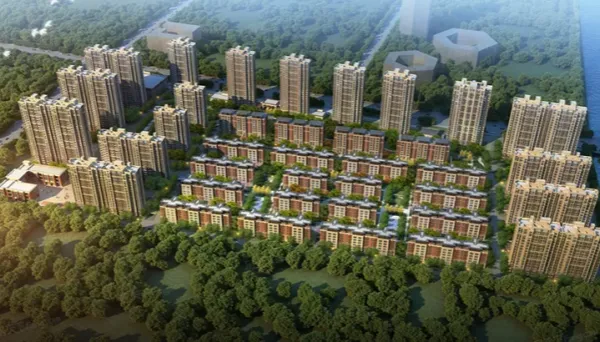
Our Putty and Latex Paint Spraying Robot completed 18,000 m² of wall finishing in just 69 hours, demonstrating the efficiency of automated interior finishing in a high-end residential project and setting a benchmark for smart construction applications.
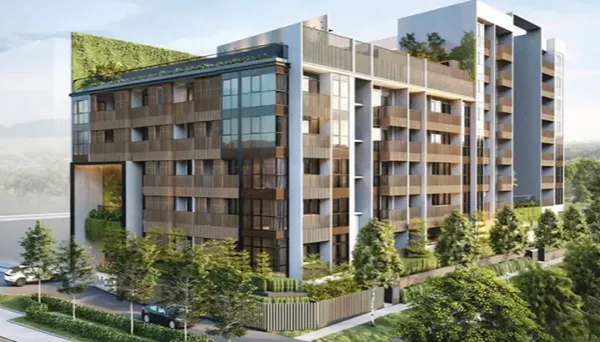
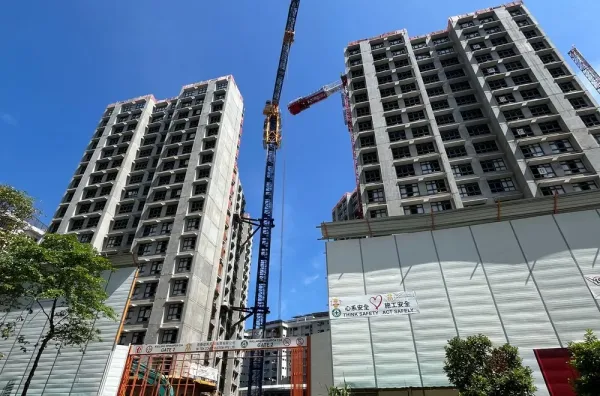
Our Putty and Latex Paint Spraying Robot was deployed in this public housing development consisting of seven high-rise residential buildings and 1,016 units. The project reduced construction time by 40%, completed six weeks ahead of schedule, reduced labor costs by 60%, and achieved the highest quality rating from Singapore’s Housing & Development Board (HDB).
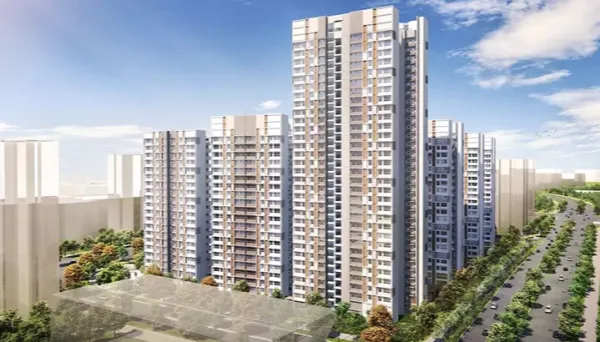
Reliability and Support
In our operational data, LQ05A and LQ07A average 0.33 failures per unit per month, or one-fifth of the referenced industry average. For LQ00C and LQ06A, dedicated mixing and integrated filtration help reduce nozzle blockage and mechanical failure risk.
Our support covers the full equipment lifecycle, including a one-year warranty for non-human-induced damage, free parts replacement and labor support during the warranty period, remote technical diagnosis, hardware replacement logistics, and two weeks of free on-site training after initial delivery to help your team operate the system effectively.
Conclusion
Our automatic wall painting robot supports thickness control through measured site geometry, process-compliant paths, controlled spray parameters, constant distance, intelligent motion, and defined material targets. LQ05A, LQ00C, LQ07A, and LQ06A apply this system to different working heights and material scopes.
When reviewing an automatic paint spraying robot, practical inputs include wall height, coating type, specified thickness, coverage, and project output. For an automatic wall painting robot for sale, these inputs help identify the relevant Legend Robot configuration without relying on unsupported assumptions.